Saturday, November 13, 2010

VFR Communications from Sporty's

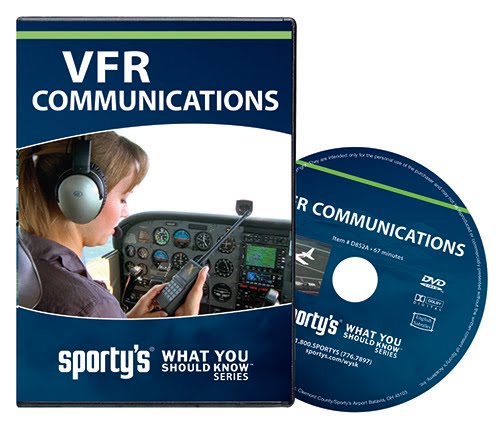
Last week I received a free review copy of Sporty's newest instructional DVD in their "What You Should Know™ Series, VFR Communications. The DVD was completely updated in September 2010. It is available from Sporty's and costs $34.95. The program is also available as a video download, also priced at $34.95.

I'm glad to have the opportunity to review this DVD, as I purchased the previous version of their VFR Communications program last year. That older version was not something I would have highly recommended. Content was somewhat limited in my opinion; it consisted mainly of short in-flight video segments of a pilot in various airspace classes without very detailed explanations. Consequently, I loaded the new DVD into my player with tempered expectations but hoping for a much-improved product.
Menu navigation is well thought-out. The main menu presents eight sections - Introduction, Non-Tower Field, En Route, Non-Standard Communications, Class D, Class C, Class B, and Communication Failures. When you click on a section, a sub-menu opens up with a short description of what content is inside and a button to play the video. As with most Sporty's instructional videos, narration is done by popular airshow announcer and pilot Rob Reider.

The video begins with an introductory chapter that does a great job of covering the basics needed for content in later chapters. Both the Aeronautical Information Manual (AIM) and Pilot/Controller Glossary are referenced as important places to find proper phraseology. The phonetic alphabet is explained and that leads into numerous examples of pronunciation - altitudes, call signs, magnetic headings, speeds, etc. I think this is critical information that reduces confusion for someone new to the language of aviation and am glad Sporty's chose to dedicate the introduction to it.

Screenshot from Chapter 1 - Introduction / General Information

Following the introduction, the video moves right into non-towered fields. I particularly liked how they have a recorded AWOS broadcast and supplemented the audio with a text transcription on screen. It seems like it would be very useful for a new student to hear both the sound and pace of an automated weather station before climbing into an airplane. The video also makes use of many helpful graphics and visualizations of the aircraft's location during various radio calls - especially in the pattern.

Communications with Flight Service (regarding VFR flight plans) and Flight Watch (regarding in-flight weather) are each given a couple minutes of good explanation in the En Route portion of the program. The simulated radar animations of an airplane's track superimposed on a VFR Sectional chart do a very nice job illustrating the usefulness of VFR Advisories, also known as Flight Following. I also thought the short segment pointing out locations where a pilot can find the proper radio frequency to call ATC for Flight Following was very well done.

The sections on airspace (Class B, C, and D) are all structured similarly. The airspace itself is first given a brief explanation and then a flight into and out of the airspace is simulated along with all requisite communication. All the radio calls appear to be simulated and the rate of speech is noticeably slowed compared to what you'll usually hear when talking with ATC. This is good for student pilots trying to learn proper communication but I do feel that it lends a slightly unrealistic tone the video.

Graphics overlaid on top of VFR Sectional charts are again used heavily and to good effect. However, I do take issue with the lack of in-flight video. The previous version of VFR Communications was chock full of in-flight video at the expense of graphics and explanations. This version tilts heavily the other direction - too far in my opinion. I think Sporty's needs to strike a better balance between in-flight video with actual radio calls and animations and graphics used to illustrate the process.

Screenshot from Chapter 7 - Class B Airspace

Even though the video covers proper radio phraseology, I really appreciate the fact they it also spend a few minutes covering non-standard communications. Lord knows every pilot has heard all sorts of gibberish over the radio before; I think it's important to expose new pilots to both the good and the bad! Similarly, a bit of explanation of Instrument procedures helps clarify what the folks out practicing approaches are talking about. While on this topic I should mention that I found it somewhat peculiar that every example in which ATC calls out traffic and the airplane does not have it in sight has the pilot saying "looking for the traffic" whereas the proper response is "negative contact" according to the Pilot/Controller Glossary.

On a small personal note I have to mention that it's kind of nice to have Sporty's in your backyard. My home drome is only about 25 miles from Clermont County Airport in Batavia where Sporty's is located. So it's neat and useful to see all the example radio calls in the video to Dayton and Cincinnati Approach plus flights to LUK and DAY - all facilities I talk to frequently! I also have to commend Sporty's for admonishing the often-heard but thoroughly unprofessional and annoying "any traffic in the area, please advise" radio call in this video.

An additional benefit of this video is the fact it qualifies for credit in the FAA Safety Team's WINGS program. For those of you who are unfamiliar, it is a safety program that encourages pilots to attain additional training beyond the basic requirements spelled out in the FARs. All you have to do is go to the Activities search section on the WINGS page and search for 'VFR Communications' and you'll see the link for the Sporty's video. Click the button to Enroll in Course and you can then take a short exam to receive WINGS knowledge credit. You may also qualify for a discount from your aviation insurance provider by watching this video.

Overall, I was satisfied with this video and have to say that Sporty's had definitely improved over the prior version. They have posted a short video clip from VFR Communications online that you may view by clicking here. I think the program does a good job explaining the variety of radio communications a VFR pilot will experience and is easy enough for a new student to understand. As mentioned above, I do take issue with the total lack of in-flight video in some segments. While the animations and illustrations are excellent, I believe actual footage of operations at Class B, C, and D airports with real radio communications would be even more beneficial. with this release. In the end, I recommend VFR Communications and consider it a fair value at the list price of $34.95 when you factor in the WINGS credit and possible insurance savings.

Rating: 4/5 Cubs

Tuesday, November 9, 2010

Streamers and a J-3

Plane: Cub, 85 hp
Route: 40I, Local
Weather: Clear, 65 degrees, wind 200 degrees at 3 knots

The weather this week has been decidedly un-fall-like with clear skies and temperatures in the upper 60s. Perfect flying weather except for the fact that the end of Daylight Savings Time means it's dark when I leave work. Fortunately I was able to use one of my banked "you've worked a ton of extra hours this week, so take off early and go flying some day" days and I headed out about 3:30.

Gina met me at Stewart and I made sure the Cub was fit to fly. After our experience doing so last week, the two of us were hooked on a new way to have far too much fun in a J-3... streamer cutting! I departed the pattern and climbed to about 4,500 feet over the lake and dropped out a roll of toilet paper. Carb heat on and the throttle back, we descended with some moderately banked turns and managed to hit the descending streamer two times before hitting my hard stop of 2,500 feet - which is 1,500 feet AGL. I climbed back up again and tossed out a second roll and this time managed to hit it once on the way down.

Here's the cockpit view from this evening's fun

Words don't do the activity justice but trust me when I say it's far too much fun. Gina had a blast as evidenced by the giant grin on her face most of the time. Please note my earlier comments about the legality of such activities if you're concerned, by the way.

The sun was setting and it was surprisingly hazy out below about 4,000 feet so I flew a slightly zig-zag course back towards Stewart so I could spot traffic better. We crossed midfield from the North side and entered a left downwind for Runway 26. It's always a treat to land that direction with the setting sun scorching your retinas but I brought us down for a very good, smooth three-point landing.

Flight Track: Google Earth KMZ File
Today's Flight: 0.6 hours
Total Time: 180.9 hours

Sunday, November 7, 2010

Pilot Toys: BrightLine Bag, two years later

In what I have to consider a testament to the BrightLine Bag's quality, my two year update is going to be quite short. My bag is still going strong and regularly carries my ever-increasing gear collection. I've used it on long trips and short trips - from a quick jaunt to Lunken for dinner to an overnight trip with a stop in Put-In-Bay to our giant, eight day circumnavigation of Lake Michigan this past summer.

The bag still carries everything I listed in the original review along with some new gear:
Needless to say, this bag holds a ridiculous amount of stuff yet still manages to keep it organized and easily accessible. The zippers and fabric have held up very well against what I would consider average use. I definitely toss the bag in my car and in the luggage area of the 150 and 172 without any concern about damaging either the bag or its contents.

The only issue I have had with my bag is that the business card holder disintegrated. I actually spoke with Ross Bishop, the owner and creator of the BrightLine Bag, at the AOPA Summit in Tampa, Florida in 2009 about this very issue. He told me that they had a manufacturing problem with some of the earlier bags; the plastic used to secure the business card holder to the fabric was too brittle. Indeed, the black plastic around the protective clear cover on my bag slowly flaked off beginning about six to nine months after purchase. Today there is no black plastic remaining (only some thread that used to secure the plastic remains) and the business card holder has completely fallen off.

Note the missing business card holder in the middle of the bag

Even with the aforementioned problem, I can't knock the bag's quality. Ross actually offered to send me a new holder without the brittle plastic that I could sew on to the bag; I just never took him up on the offer. More importantly, the bag has held up perfectly in every area that counts - the zippers and fabric look as good as new and it has kept all my stuff safe and secure for nearly two years now. I can't recommend the BrightLine Bag enough for any pilot that's looking for a well-organized bag to carry their flight gear.

If you're interested in purchasing a bag of your own, click here!

Updated Rating: 5/5 Cubs


When I received my BrightLine Bag for Christmas in 2008, I was a newly minted Private Pilot. Nearly all my cross-country flying had been during my training and I didn't have much to carry with me most of the time. I have since acquired more gadgets (in other words, I'm your average pilot) and tend to keep a few more things with me whenever I go flying.

What I never expected was for my original review of my BrightLine Bag to become so popular. If you search for 'BrightLine Bag' on Google, that blog post is in the Top 5 results listed. In fact, since that post went live nearly two years ago, I have written 108 posts on here but over 6% of the blog's entire traffic count comes directly from my review.

So it should come as no major surprise that I was contacted by the guys at BrightLine Bags a few months ago. It's pretty easy to track statistics on the web (as I just did in the previous paragraph) and they've noticed that a significant amount of traffic comes from my blog. I'll cut right to the chase - I am now an affiliate with them and will receive a small commission if you purchase a bag through a link on this site.

It is clear that my review has had - and is still having - an influence on people who are considering purchasing a BrightLine Bag. I'm glad to help out fellow pilots and am actively working on increasing the number of reviews on this blog. While I do try to keep advertisements on here to a minimum, I realize there is a great opportunity here to work with BrightLine. Neither the original review nor this updated version have been in any way influenced by my affiliation. All the thoughts and opinions on this blog are strictly mine.

All I'm asking of you is this - if you decide to purchase a BrightLine Bag based upon my reviews, I would greatly appreciate it if you do so through one of the links in the posts or on the navigation bar on the right-hand side of the blog. Thanks!

Sunday, October 31, 2010

Book Review: Jet Age by Sam Howe Verhovek

I recently was given the opportunity to review a new book, Jet Age: The Comet, the 707, and the Race to Shrink the World by Sam Howe Verhovek. It was released on October 14, 2010 and is available for about $15. Grade school book reports aside, I have not ever formally reviewed a book before so I'll do my best and happily accept your criticism.

My bookshelves are full of great aviation books that I have purchased over the past few years and fully intend to read. I never seem to have enough free time and am ashamed to admit that I probably have 30+ books whose pages have never seen the light of day. So I must note that having a timeline to read Jet Age and write a review was a nice motivating factor... I might need to try this more often!


Verhovek has done a marvelous job weaving together the fabric of the players and engineering feats that produced what he refers to as the Jet Age. He successfully takes you on a journey from the tragic crashes of the de Havilland Comet in 1954 to the post-war race towards turbojets in commercial aviation and back to the Comet's triumphant return, operating the first commercial service across the Atlantic. Along that journey are exceptional personal accounts and bits of history that bring a wonderful human element to the story.

I was taken aback by some of the knowledge contained in the book. While my aviation history knowledge is reasonable, it quickly became clear just how well Verhovek can highlight the nuances that allow the reader to envision the full picture. I never realized how much parallel development of the turbojet engine was underway on both sides during World War II, for example. The scientific knowledge was there but the British government simply didn't see the potential and slowed progress through a lack of funding. We all know that the Germans felt differently and the result was the Messerschmitt Me 262.

One particularly interesting passage of the book is in regards to Bill Boeing's avant-garde way of promoting aviation prior to World War I. He once, "flew over downtown Seattle and began dropping hundreds of red cardboard propaganda leaflets shaped like artillery shells ... a few weeks later, he did it again, this time over a packed stadium of fans watching a football game..." Is it compelling to read how he helped convince citizens and the US Government of the importance of aviation in those early days. However, it is even more amazing to consider that such a stunt today would likely end with F-15s off your wingtip and a less-than-desirable run-in with the TSA, FBI, and/or FAA later on the ground!

The sudden post-war race (in some eyes) towards commercializing turbojet airplanes is where the bulk of the book is spent, and for good reason. It truly is fascinating to understand the pressure the British were under with the Comet and see how that completely transformed the feelings about jet aircraft in the United States. Boeing capitalized on this movement away from propeller-driven airliners with a particularly interesting driving force - tax breaks. Government tax rules after WWII essentially gave Boeing a reason to invest heavily in R&D and that led directly to the Dash-80 (707) program.

I loved the in-depth analysis of what really occurred on the drawing boards at de Havilland, Boeing, Douglas, and other manufacturers during this period of aviation history. Their engineers were brilliant, their leaders visionary, and their salesmen smart and adaptive. Nothing better exemplifies the era than Alvin "Tex" Johnson's famous August 7, 1955 barrel roll in a 707 over Lake Washington. The book contains a wonderful exchange Tex had with Eddie Rickenbacker following that vintage barnstorming stunt, a stunt that also helped Boeing sell a lot of airplanes.

Verhovek's branching out throughout the book is what brings such depth to the story. It's not just what happened, but who was behind it and who they were. Bill Allen, an unassuming lawyer from Montana who might now be best described as a visionary, led Boeing out of a post-war funk and transformed them into possibly the most successful aircraft manufacturer in history. From the airlines and their famous leaders like Rickenbacker (Eastern) and Juan Trippe (Pan Am) to the shifting culture, you see how much this era changed the course of not just aviation but our entire worldview.

It's sometimes hard to believe how much progress was made in such a short time. The Wright Brothers first flew at Kitty Hawk in 1903 and by 1958, only 55 years later, you could fly from New York to Paris under nine hours. In Jet Age: The Comet, the 707, and the Race to Shrink the World, Sam Howe Verhovek tells the riveting tale of what transpired to make this possible.

Rating: 5/5 Cubs


Full disclosure - I was contacted by the publisher in early October and asked if I would like a free review copy of the book in exchange for writing a short review. All thoughts and opinions are 100% my own.

If you decide to purchase this book based upon my review, I would appreciate if you do so by clicking on one of the Amazon links in this post. It really helps support the blog. Thanks! -Steve

Friday, October 22, 2010

Crankin' and bankin'

Plane: Cub, 85 hp
Route: 40I, Local
Weather: Clear, 61 degrees, wind 250 degrees at 5 knots

This was a short, simple flight - sometimes the kind that's the most fun. I was staring out the window all day at work at yet another October afternoon of wonderful CAVU conditions. That means I have to go flying if a plane's available, of course. The big Cub was open so Gina and I headed to Stewart at about 5:15 and CFI Dave hand-propped the 85 horse Continental to send us on our way.

I love the cool fall air - we were already at 1,500 feet by the end of the runway and I departed to the south. The climb up to about 4,000 feet was rather quick and we enjoyed the view even though most of the colorful leaves have already fallen to the ground. Gina's never done a wingover (I did them with Dave last year) so I asked if she'd like to do a few. Apprehensive until I explained them, she agreed and I did a couple after the requisite clearing turns.

I must note here that what I call wingovers aren't aerobatic maneuvers. Instead, it's a gentle pitch down to build airspeed followed by a pull up to an attitude less than what you'd usually see during power-on stall practice. The engine torque rotates the wing over so that the plane banks and descends without any additional control input. So, in summary, it's a non-aerobatic maneuver that does not require a parachute per FAR 91.307.

Next up was something I've long heard about but haven't ever done on my own - streamer cutting. I climbed back up to over 4,000 feet, cleared the area of traffic, flew over the lake and tossed about a quarter roll of toilet paper out the window. It quickly unfurled and I spotted it as I flew past and made a 180 to head back. I got close on the first pass but the streamer was still about 50 feet to the left of the airplane. After another pass to get in better position I pointed the nose at the streamer and split it into two pieces with the left wing... success!

Again, a note about the legality of such things since I am posting this publicly. FAR 91.15 states that the regulation "does not prohibit the dropping of any object if reasonable precautions are taken to avoid injury or damage to persons or property." We were over a large lake, toilet paper is lightweight and highly biodegradable, and I stopped when we were above 1,500 feet AGL. Based on this, all precautions were taken and the streamer cutting shown in this video was completely safe and legal.

That was a whole bunch of fun and I've got to recommend it as long as you take all precautions, follow all regulations, and fly the airplane safely within its envelope. Sorry for all the legal rambling above but I don't want anything I post here to be misconstrued since I am posting it online. I had Gina take the controls briefly and she flew us into the pattern, then I took back over and brought us around to land. The setting sun was directly in my eyes on final but I still managed a perfect three-point landing, touching down just as I pulled the stick all the way back. Maybe a little luck was involved, but I'm not complaining!

Flight Track: Google Earth KMZ File
Today's Flight: 0.5 hours
Total Time: 180.3 hours